Flower Sieve Weaving Basket
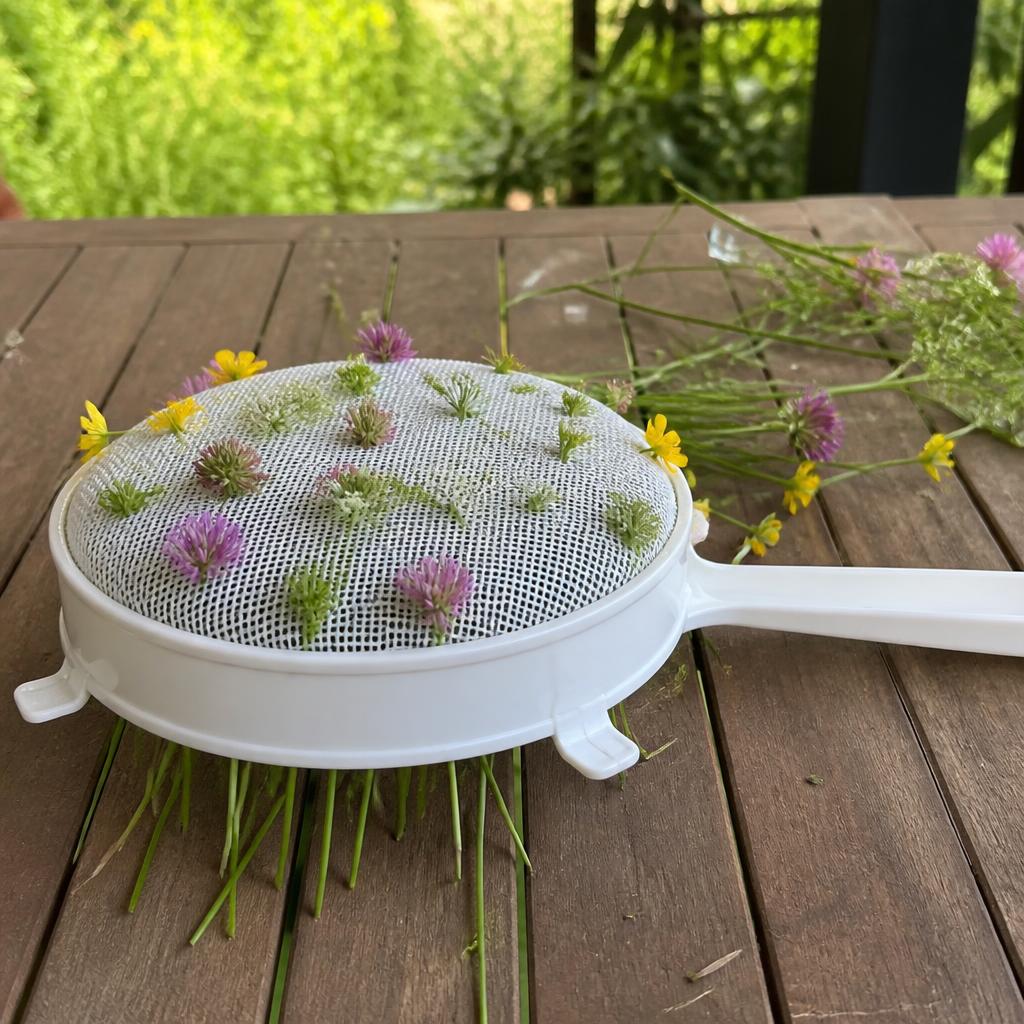
An everyday kitchen sieve becomes a natural loom: children thread wildflower stems through the holes during a slow walk outside, turning foraged blooms into a living garden picture.

An everyday kitchen sieve becomes a natural loom: children thread wildflower stems through the holes during a slow walk outside, turning foraged blooms into a living garden picture.
Place the empty sieve and scissors in the basket the night before so the invitation is ready.
Head outside for a slow walk together. Invite your child to choose flowers with thin stems that feel strong enough to push through a hole — not too woody, not too floppy.
Snip stems to about 10-15 cm so they are easy to thread. Leave a few longer stems for variety.
Sit on the grass or at a garden table and hold the sieve steady. Show your child the one simple rule: flower head on top, stem pointing down.
Take one flower and push its stem down through a hole from the top of the sieve. Pull gently until the flower head rests on the upper surface and the stem hangs down underneath.
Keep adding flowers next to each other, always heads up and stems down. The flowers will hold themselves in place without any glue or tape.
Encourage your child to fill the sieve in sections: one color here, a cluster of grasses there, a ring of daisies around the rim.
If a stem breaks, that is part of the activity — set it aside and try a different flower. Talk about which stems are strong and which are fragile.
When the sieve feels full enough, stand it upright on the table or hang it by its handle from a low branch so the flower heads face out and catch the breeze.
Leave it outside for the afternoon, then gently pull the stems out and return them to the garden when you are done.
This is a wonderful activity for building fine-motor control and patience. The holes in the sieve give just enough resistance to be satisfying. Avoid flowers with very thick or milky stems, and remind children to leave plenty of blooms for the bees. It works beautifully in spring and summer when wildflowers are abundant.